Six pillars. One deployable stack. The registered EU Digital Identity Wallet verifier, telephony and call-traceability platform for EU wholesale telecoms.
CTIC is a self-hosted, six-pillar XaaS platform from Aloaha Limited that gives European wholesale telecoms operators a production-live EU Digital Identity Wallet verifier already listed on the EU Reference Registry (registry.serviceproviders.eudiw.dev, entity CodeB / Aloaha Limited, VATMT14814406, IDPC Malta supervisory authority), plus a full-stack EUDI Wallet issuer, hosted holder PWA, browser-native SIP-over-WebSocket telephony, a database-free self-hostable stack, QES / AdES digital signatures — including wallet-driven remote signing via CSC v2 — interoperable eForms and EN 16931 XInvoice / XRechnung / ZUGFeRD e-invoicing, in one integrated binary. A voluntary industry-wide call-traceability plug-in rides on top: originating carriers, wholesale interconnects and terminating retailers attach a chain-of-trust attestation to every call, sovereign and eIDAS-native. CTIC is Aloaha Limited’s global innovation beacon for the EU telecoms sector.
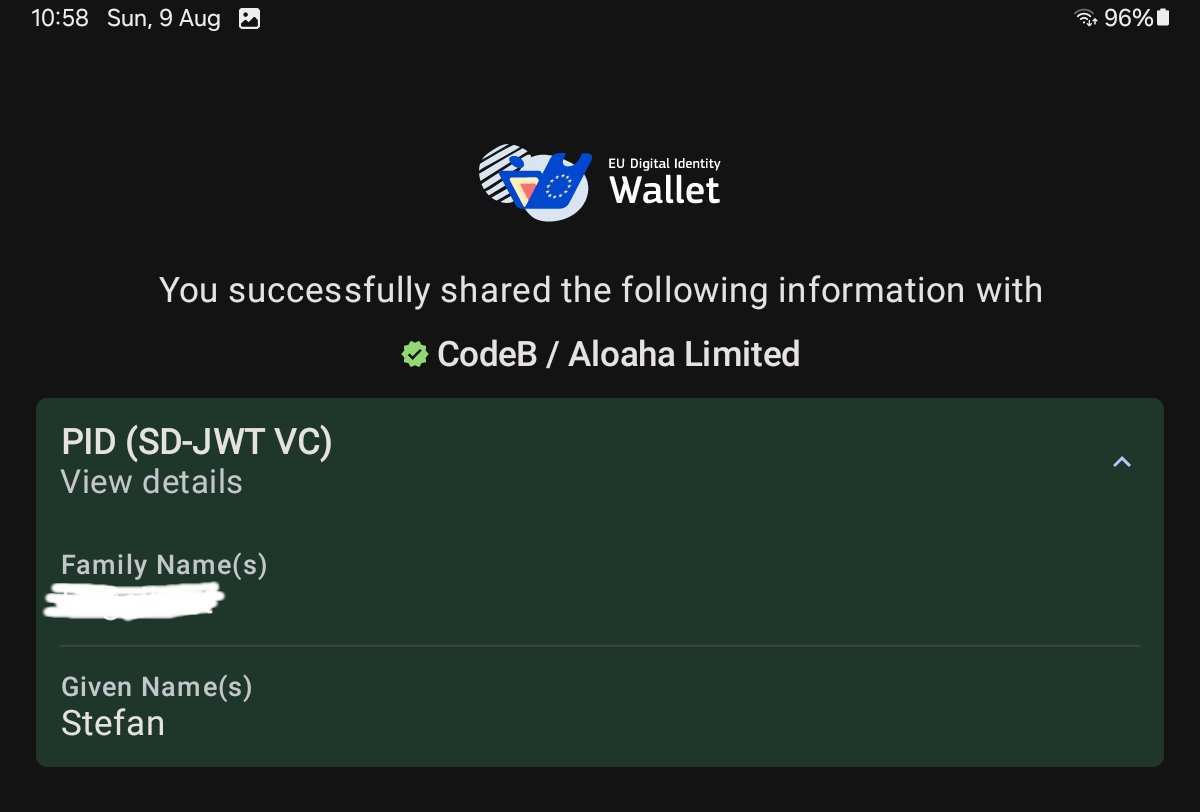
eIDAS 2.0 applies to the entire European Economic Area — 30 countries in total. The 27 EU Member States must offer at least one certified wallet by December 2026 and accept it at regulated touchpoints including SIM registration, eSIM activation, number portability and B2B onboarding; Norway, Iceland and Liechtenstein follow with roughly one additional year of lag. CTIC is one of the very first EU-shipped EUDI Wallet verifiers delivered as-a-Service to be registered on the EU Reference Registry today, and among the first production-ready platforms to pair that verifier with a voluntary call-traceability plug-in for the wholesale-to-retail chain. The screenshot below is the actual success screen from the EU Reference Wallet after a live PID (SD-JWT VC) presentation to this platform on 2026-08-09.
Sovereign SBC SIPS / RFC 5630 E-Invoicing SDK Full feature list REST + webhook APIs Get your own tenant
For wholesale · not for end users
Built for the buyers who sit between the platform and the retail subscriber.
CTIC is a wholesale-shaped, six-pillar XaaS deployment. It targets organisations that resell connectivity, identity and voice services to downstream partners — MVNOs, MVNEs, eSIM brands and national carriers included — and are directly exposed to the 2027 EU Digital Identity Wallet acceptance obligations at the moment a subscriber is onboarded, activated or ported. CTIC is a self-hosted, six-pillar XaaS platform for wholesale telecoms.
The four 2027 touchpoints where CTIC replaces manual KYC and paper-based flows: SIM registration, eSIM activation, number portability and B2B account onboarding. Each is a regulated moment. Each currently costs the wholesale operator hours of manual verification per subscriber, per port, per new corporate account. CTIC turns each into a wallet-presentation flow that completes in seconds, with a signed, tamper-evident verification receipt kept in the operator's own filesystem.
The first-mover position
Among the very first EU-shipped EU Digital Identity Wallet verifiers delivered as-a-Service.
CTIC is production-ready and among the first EU-shipped EUDI Wallet verifiers delivered as-a-Service. It ships six market-first pillars in one integrated binary: an EU Digital Identity Wallet verifier that speaks the OpenID for Verifiable Presentations profile and accepts SD-JWT Verifiable Credentials over the high-assurance interoperability profile (HAIP), browser-native SIP-over-WebSocket telephony, a database-free self-hostable runtime, eIDAS QES-sealed signatures, interoperable eForms and EN 16931-aligned XInvoice / XRechnung / ZUGFeRD e-invoicing — delivered as installable software the operator runs itself.
The 2027 acceptance mandate is not a suggestion. It is a hard obligation on any organisation whose customer-onboarding flow triggers the eIDAS 2.0 acceptance requirement. Wholesale telecoms operators sit at every one of those triggers. The organisations that deploy a wallet verifier before the deadline capture two things: procurement leverage against retail partners still scrambling for a verifier of their own, and a regulatory-alignment story that lands with national regulators, ministries and enterprise procurement.
Shipped in the last 90 days · production-live · last update 2026-08-10
The verifier is now a registered, EU-listed EU Digital Identity Wallet platform.
The six pillars anchor CTIC. Since the wholesale rollout began, the platform has extended the identity pillar into a full self-hosted EU Digital Identity Wallet stack — registered Wallet Relying Party on the EU Reference Registry, EJBCA-issued wrp.p12 JAR-signing certificate, JAdES-B intended-use attestation, verifier + issuer + hosted holder PWA, LOTL-anchored trust chain, OpenID Federation 1.0, W3C Bitstring Status List, W3C VCDM 2.0 (JOSE envelope), four DID methods, Wallet Instance Attestation, cross-tenant trust federation, EU-Ref-CA autofetch and per-check attestation reports — and hardened the telephony and communications pillars around it. Everything below is deployed and reachable on Aloaha Limited's production tenants today (phone.codeb.io, phone.aloaha.com).
Fifteen chips visualise ninety days of shipments — the newest row (mDoc / ISO 18013-5 primitives, OID4VP QR camera scanner, OID4VCI authorization_code + PAR + PKCE) landed on 2026-07-20; between then and 2026-08-10 the platform also gained an EU-Registry entry, a registry-issued wrp.p12, LOTL trust-chain enforcement, the CSC v2 remote signature service and the Cross-tenant Trust Federation shortcut listed below. Amber chips extend the EU Digital Identity Wallet pillar; blue chips harden the telephony and communications pillars. Diagram viewBox 800x264 scales to 380px mobile.
- Wallet Attestation endpoint (HAIP interoperability profile). Wallet-instance attestations issued and validated on the operator's own tenant, so downstream relying parties see a full chain of trust from wallet instance through verifier to their own trust store.
- OpenID4VCI issuer. The same platform that verifies presentations now issues Verifiable Credentials over the pre-authorized_code flow, with a per-tenant admin UI for defining credential types, key rotation and revocation.
- Hosted holder wallet PWA. A self-hostable, installable Progressive Web App that lets operators offer their own subscribers a wallet without waiting for national scheme apps. Zero-knowledge backup between devices via the operator's own OIDC store.
- OpenID Federation 1.0 discovery. Wallets and other relying parties can discover the operator's trust anchor at
/.well-known/openid-federation, ready for the incoming federation-based EU trust model. - List-of-Trusted-Lists poller. Continuously refreshes the EU trust list and validates
x5cchains presented at the verifier, so no manual trust-store rotation is required. - Per-tenant EU Wallet audit log. Every wallet presentation is written to a per-tenant, greppable audit trail; the tenant's CISO and DPO have full auditability over identity flows without leaving the operator's own filesystem.
- Public verifier conformance test. A third party can point their wallet at the operator's verifier and inspect the presentation exchange end-to-end — useful for RFP responses, procurement diligence and downstream retail-partner reassurance.
- Per-trunk SDES SRTP. RFC 4568 SDES SRTP is available per-trunk across every bridge in the SBC, so signalling and media stay encrypted regardless of the interconnect partner's posture.
- ACL v3 with hot-reload and auto-blacklist. Signalling scanners at well-known OVH and other hosting ranges are auto-blocked on startup; per-tenant allow-lists reload without a service restart.
- Multi-tenant chat platform with drop-in widget. Direct messages, groups and file transfers between tenant users, plus a per-tenant visitor widget that lets a wholesale operator embed one line of script on their own retail-portal.
- Stereo per-trunk call recording and transcription. Per-trunk and per-virtual-number toggle. Recordings are stereo PCM16 WAV; transcripts flow into the per-tenant audit trail with sharable links the operator controls.
- Growing mDoc / ISO 18013-5 pipeline. CBOR, COSE_Sign1 and mDoc primitives are in the codebase today — end-to-end mDoc issuance and presentation is progressing through the same production tenants that already run the verifier.
Next up · wallet-driven remote signing · scoped, dated, on-schedule
Two tracks to complete wallet-driven remote signing on top of the CSC v2 RSSP.
The Cloud Signature Consortium v2 REST surface shipped in the last sprint (see the milestone list above). Two additional tracks complete the wallet-driven remote signing story so a subscriber can scan a QR in a browser and sign a PDF with their EU Digital Identity Wallet against this platform. Both tracks are scoped, reference-repo-aligned and behind honesty-gated feature flags (see the EU RQES reference library).
Track 1 · QR-scan RP flow (wallet-centric, ~5 dev days)
Subscriber loads Sign with your EU Wallet, uploads a PDF, scans a QR from the browser. The wallet uses its OWN QTSP (e.g. walletcentric.signer.eudiw.dev) to produce the signature, then POSTs the signed PAdES back to our oidc.ashx?action=vp-response. Reuses ~75% of the OID4VP verifier already in production — JAR signing via wrp.p12, request_uri storage, response_uri receiver, same-device cookie binding, session poll.
Wire format: DCQL with credentials[].format = https://cloudsignatureconsortium.org/2025/x509 plus base64url transaction_data[] of type https://cloudsignatureconsortium.org/2025/qes per the EUDI RQES Kotlin reference. Zero dependency on our own QTSP.
Track 2 · CSC v2 wallet-driven RSSP (QTSP-centric, ~10 dev days)
Our tenant IS the QTSP. The EU Reference Wallet's RQES UI SDK drives our csc.ashx directly: OID4VP-driven service auth, second OID4VP round per signing (SAD implicit in Bearer), signHash, and a small SCA sidecar (calculate_hash + obtain_signed_doc) wrapping the existing PadesInlineSigner.cs. Deep-link redirect URIs (wallet://, rqes://) and PKCE S256 enforced.
Revenue model: per-signature meter (vc.sign.qes) counted the same way as vc.login.eudi. Slice A/B/C/D shippable independently; the full track completes eIDAS Advanced Electronic Signature (AdES) via wallet with a documented upgrade path to Qualified Electronic Signature (QES) once a QTSP-issued signing key is onboarded.
Both tracks are scoped and filed against the platform’s live TODO list. See the canonical wallet-driven rQES specification for wire-level detail. Honesty note: the spec is explicitly flagged pre-release, still work in progress at both the EUDI Kotlin library and the German BSI Blueprint — we ship each track behind a per-tenant feature flag so wire churn during the 2026 ARF Refinement Round doesn’t destabilise production.
ARF 3.0.0 · released ~late July 2026 · three-layer RP + two-cert + Intermediary role
ARF 3.0.0 fit — and the Intermediary opportunity CTIC is already shaped for.
The European Commission published Architecture and Reference Framework (ARF) 3.0.0 at the end of July 2026. It is the biggest ecosystem change since the 2024 launch: every Relying Party is now decomposed into three formal layers, every service ships with two complementary certificates, and a new Intermediary role lets one party carry the registration and certificate lifecycle for many downstream Relying Parties. CTIC is already the right shape for all three shifts. What follows is an honest split of what we ship today, what maps to the new model, and what we are formally adding.
The ARF 3.0.0 three-layer Relying Party structure. One legal entity may run multiple RP Instances (datacentres, DR sites, tenants). Each Instance exposes one or more Services, each with its own Registration Certificate declaring the exact Intended Use the wallet will let the user share. The wallet now shows the SERVICE name, not just the org name, on its consent screen.
What we ship today that already maps
- wrp.p12 (EU-Registry-issued via EJBCA) acts as the Access Certificate at the RP Instance layer.
- intended-use.jades (JAdES-B with the WIA EUDI extensions per ETSI TS 119 182-1) is the anchor for the ARF 3.0.0 Intended Use concept.
- Service-shaped DCQL builders already exist —
BuildEudiLoginQuery,BuildAloahaIdentityQuery,BuildAloahaAgeQuery, and the roadmapped signing builders. Each maps 1:1 to a distinct RP Service in the ARF 3.0.0 sense. - Per-tenant registration flow (14-step tree walker at
eudiw-register.ashx) can be extended to loop-register multiple services under one legal entity.
What is being added for full ARF 3.0.0 conformance
- Per-service Registration Certificates under EU Regulation 2024/2982. New
?action=register-rcflow that mints one RC per RP Service, cryptographically bound to the Access Certificate and the service’s Intended Use list. - Multi-service intended-use JAdES emission so each service ships its own JAdES token alongside the tenant-wide baseline during the transition.
- Public verifier metadata refresh —
/.well-known/eudi-relying-party.jsongains aservicesarray with per-service RC references. - eudi-registration.html public proof extends to show BOTH cert chains per service — AC (who) and RC (what) — with expiry, thumbprint and Intended Use for each.
The Intermediary opportunity — CTIC as managed compliance for SMEs.
ARF 3.0.0 formalises the Intermediary role: a special Relying Party that acts on behalf of one or more other Relying Parties, handling Wallet communication without ever storing the content of the transactions it forwards. Not every organisation wants to run its own EU Reference Registry registration, its own EJBCA-issued wrp.p12 lifecycle, its own per-service RC minting and renewals, its own JAdES-B intended-use signer, its own LOTL trust chain check. Most European SMEs — medical practices, MVNOs, hospitality operators, notaries, insurance brokers, retail chains — will not build any of that in-house. This is exactly the compliance-overhead-into-recurring-revenue shape CTIC has been architected for.
CodeB positioned as an ARF 3.0.0 Intermediary. One registration surface to the EU Reference Registry; per-downstream-RP AC + RC issuance and renewal handled by CodeB; the end user still sees only the downstream RP’s name on the wallet consent screen, with Intermediary involvement recorded in the wallet audit log per ARF 3.0.0 traceability rules. This is the missing managed-service layer the SME market has been waiting for.
- Formal mandate flow. Each downstream Relying Party signs a mandate authorising CodeB to act on its behalf; mandate captured via the existing European Business Wallet director-signed workflow. The Registrar verifies the mandate before issuing the RC.
- Per-tenant Intermediary mode. A single
intermediary=trueflag on the tenant switcheseudiw-register.ashxfrom RP mode to Intermediary mode. Same pipeline, same certificates, different registration frame. - Downstream RP visibility, not Intermediary visibility. The wallet consent screen shows the downstream RP’s tradeName + verified badge, not CodeB’s. Intermediary involvement is captured in wallet audit logs per the ARF 3.0.0 traceability requirement — useful for compliance, invisible to the user.
- Metered like everything else. Per-downstream-RP and per-Service meters on the same
clientRefplumbing already used for wallet verifications, CSC v2 signHash calls, call minutes and AI tokens (see the wholesale distribution section below). - Legal template. An ARF 3.0.0 Intermediary Mandate Template ships alongside the existing DPIA + RoPA templates — per-tenant configurable via compliance-admin.html.
Positioning note. The three-layer RP structure, the two-certificate model, and the Intermediary role are new formal concepts — the underlying capabilities they organise (AC-style tenant cert, service-scoped attribute lists, third-party managed compliance) have been shipped in CTIC for months. What ARF 3.0.0 gives us is a common vocabulary to describe an offer the SME market has been asking for and no other EU-sovereign vendor is yet positioned to deliver at price. Sales language: “Compliance is a moat when you don’t have to build it yourself.”
Architecture
One deployable stack. Six load-bearing pillars.
CTIC is not a suite of separately-licensed products bolted together. It is one integrated binary that presents six pillars to the operator, each labelled with the exact standard it implements. Every pillar is switchable on or off per tenant, per trunk, per user — so a wholesale operator can start with just the EU Digital Identity Wallet verifier and extend into telephony, signatures, eForms and e-invoicing as their retail programme grows. CTIC is a self-hosted, six-pillar XaaS platform for wholesale telecoms.
CTIC platform architecture — six pillars, one deployable stack. On mobile the two-by-three grid reflows vertically at the same aspect ratio; the SVG viewBox scales fluidly with the container down to 380px widths.
Wholesale distribution
Multi-tier tenancy that keeps every customer relationship end-to-end.
CTIC is wholesale-shaped at the tenancy layer. Aloaha bills the platform tenant. The platform tenant bills its distributor tenants. Each distributor bills its reseller tenants. Each reseller bills the end-customer. Every event carries a clientRef slot so revenue is attributable at any tier — and every tenant owns its own subscriber list, call detail records, recordings and transcripts inside its own domain, end-to-end.
Each tenant is an independent per-domain partition on disk. Every subscriber list, CDR, transcript and recording stays inside its own tenant boundary, owned end-to-end by whichever party in the wholesale-to-retail chain the data belongs to. Diagram remains legible at 380px mobile widths thanks to the responsive viewBox.
Voluntary call-traceability plug-in · sovereign, eIDAS-native
A voluntary plug-in that aligns wholesale and retail telecoms against unidentifiable-call fraud.
CTIC offers global mobile operators, MVNOs, eSIM brands, telecom retailers and their wholesale peers a voluntary plug-in solution to the long-standing traceability problem for unidentifiable calls. Because the same platform runs the EU Digital Identity Wallet verifier, per-trunk SIP-over-TLS, per-trunk SDES SRTP, per-tenant OIDC identity and RFC 4028 Session-Timer, it can attach a chain-of-trust from originating carrier through interconnect to terminating retailer — voluntarily, without waiting for a regulator to mandate it. The six-pillar delivery makes it operationally cheap to adopt: no separate KYC vendor, no separate signalling-protection vendor, no separate identity IdP. This is the missing piece the wholesale-to-retail chain has been waiting for.
The plug-in is designed as the sovereign, eIDAS-native alternative to the US regulatory-driven approach. It attaches a signed attestation at each hop — originating carrier, interconnect, terminating retailer — so the terminating operator and, ultimately, the retail subscriber can see the verified origin of the call. Because CTIC already terminates SIPS, mints per-tenant certificates and issues QES-sealed signatures across the same tenant boundary, no new vendor is needed. Any operator can opt in on their own timeline, and the chain-of-trust flows through only the CTIC-enabled hops.
CTIC-attested chain-of-trust across originating carrier, wholesale interconnect and terminating retailer. Each CTIC-enabled hop attaches a signed attestation the terminating retailer and the verified end-user can inspect. Diagram viewBox 800x260 scales fluidly to 380px mobile.
- Voluntary industry-wide plug-in. Not a regulatory mandate. Any operator, MVNO, eSIM brand, wholesale distributor or retail carrier can opt in on their own timeline — the chain flows through only the CTIC-enabled hops.
- Sovereign, eIDAS-native. Built on eIDAS 2.0 primitives — EU Digital Identity Wallet presentations, QES signatures, per-tenant certificates. No dependency on non-EU regulatory frameworks or non-EU trust anchors.
- Attach the attestation without adding vendors. The six pillars are already in the box: no separate KYC vendor, no separate signalling-protection vendor, no separate IdP. The plug-in reuses what CTIC already ships.
- Wholesale-to-retail chain-of-trust. The attestation attaches at originating carrier, wholesale interconnect and terminating retailer, so the retail subscriber ultimately sees a verified origin for their inbound call.
- Aligns wholesale and retail incentives. Wholesale interconnects that opt in get a differentiator; retail carriers that opt in reduce fraud losses on unidentifiable calls; end subscribers get an inspectable proof.
The 2027 acceptance mandate · four wholesale touchpoints
Where CTIC turns each regulated moment into a wallet flow.
Each of the four touchpoints below is a moment where an EU Member State regulator will, from 2027, expect the wholesale operator to accept an EU Digital Identity Wallet presentation as a valid identity assertion. The flow is the same shape in each case: the subscriber presents from their wallet, CTIC's verifier validates cryptographically, and the operator activates or ports.
SIM registration
Retail SIM sale by a distributor or MVNE. Wallet presentation replaces paper-based ID capture and manual KYC. Verification receipt stored in the reseller tenant's partition.
eSIM activation
Travel-eSIM and consumer-eSIM aggregators face the highest onboarding volume in the sector. Wallet-first onboarding eliminates the SMS-OTP fallback that keeps failing across roaming boundaries.
Number portability
Number-portability fraud costs European carriers hundreds of millions annually. A wallet-presented port authorisation carries cryptographic non-repudiation the losing carrier can inspect.
B2B account onboarding
Corporate customer onboarding: legal-entity credentials plus signatory authorisation, both wallet-issued. The signed presentation is the contract prerequisite.
Capability breadth
Everything the wholesale operator needs in one stack.
CTIC's XaaS breadth is deliberately unusual for the category. A typical wholesale procurement bundles a verifier from one vendor, an SBC from another, a CPaaS from a third, an e-invoicing SDK from a fourth and a metering system from a fifth. CTIC ships all of the following out of one install.
EU Digital Identity Wallet verifier
OID4VP + HAIP + SD-JWT VC. x509_hash (mandated by HAIP 1.0 Final) and x509_san_dns (additional OpenID4VP compatibility mode) client-identification schemes. Production-shipped. Cited in ministerial correspondence.
Sovereign SBC
Multi-tenant SIP border with per-trunk TLS, per-trunk SRTP via SDES, ICE-Lite for STUN-less hardphones, per-source-IP auto-blacklist.
SIP-over-WebSocket
Browser-native RFC 7118 endpoint. WSS transport terminated at the SBC. Sits alongside UDP/TLS listeners without rearchitecting routing.
SIP-over-TLS (SIPS)
RFC 5630 SIPS on TCP 5061/6061, per-tenant certificates by SNI, ACL and auto-blacklist shared with the WebRTC surface.
WebRTC SFU
Selective forwarding unit for meetings beyond mesh peer count. Composite trigger on bandwidth and participant count. Client preference honoured.
Programmable AI voice
Receptionist, outbound caller and transcription. Per-virtual-number prompts. Bring-your-own AI provider key. Per-trunk transcription tap.
E-invoicing SDK
ZUGFeRD, XRechnung, Factur-X. Reads UBL, writes CII per EN 16931. On-premise library; no cloud round-trip for invoice generation.
Chat with embed widget
Real-time chat plus a drop-in visitor widget. Per-tenant origin allow-list is the trust boundary; no OIDC required from the visitor.
Per-trunk recording & transcription
Stereo PCM16 WAV per call, admin UI, retention policy, fan-out to matched tenants. Transcript emission is a per-trunk toggle.
Wholesale-billable metering
Every event carries clientRef. Counted entitlements plus consumable budgets. LicenseGate stub is Allowed-true until deals close.
Standards compliance readiness
NIS2 · DORA · eIDAS 2.0 · EU Cyber Resilience Act · EU AI Act · GDPR Art. 32. Documented alignment across each layer.
Wallet Attestation
HAIP interoperability profile. Attestations issued and validated on-tenant so relying parties see a signed chain from wallet instance through verifier to trust store.
OpenID4VCI issuer
Same tenant that verifies presentations now issues credentials via the pre-authorized_code flow. Per-tenant admin UI for credential types, key rotation and revocation.
Hosted wallet PWA
Installable Progressive Web App the operator hosts for its own subscribers. Zero-knowledge cross-device backup via the operator's own OIDC store.
Trust-list poller
Continuous EU List-of-Trusted-Lists refresh with x5c chain validation at the verifier. No manual trust-store rotation.
Per-tenant EU Wallet audit
Every VP presentation lands in a greppable per-tenant audit trail. CSV export. Full auditability without data ever leaving the operator's filesystem.
OpenID Federation 1.0
Wallets and relying parties discover the operator's trust anchor at /.well-known/openid-federation. Ready for the incoming federation-based EU trust model.
Multi-tenant chat platform
Direct messages, groups, file transfers between tenant users, plus a per-tenant visitor widget the operator embeds on its retail portal with one line of script.
Public conformance test
Third parties can point their wallet at the operator's verifier and inspect the presentation exchange end-to-end — RFP-ready, procurement-inspectable.
Filesystem storage
No SQL, no NoSQL, no embedded database. NTFS atomic writes with .backup shadow. Per-tenant partition. DR is a folder copy.
Sovereignty · no middleman
Self-hosted. No national-identity-cloud in the loop. DR is a folder copy.
A wholesale telecoms buyer's regulatory exposure is directly proportional to the number of vendors sitting between their subscriber and the identity-assertion outcome. CTIC removes middlemen from that chain.
- Self-hosted on operator infrastructure. Deploy inside the operator's own datacentre, a sovereign-cloud region or a colocation cabinet. No Aloaha-side data plane. No mandatory outbound telemetry.
- No national-identity-cloud middleman. The wallet verifier speaks directly to the presenter and the operator's own trust store. The operator does not route identity presentations through an intermediary hosted-verifier service.
- Filesystem-only state. Every setting, every credential store, every recording, every transcript, every CDR is a file on disk in a per-tenant directory. No SQL server dependency. No database patch window.
- Disaster recovery is a folder copy. Snapshot the tenant directory, ship it to a warm-standby node, start the process. No schema migration. No point-in-time restore ceremony.
- No hyperscaler tie-in. The stack runs on .NET Framework 4.8 on any Windows Server. Cert issuance uses public ACME. Storage is native NTFS. Nothing forces the operator into a specific cloud provider.
- Explicit DPO/CISO-friendly logging. Every trust decision leaves a greppable INF-level log line at entry, branch, pre-call and post-call. Auditable by human inspection alone.
Head-to-head
CTIC vs the largest CPaaS incumbents.
The largest hyperscaler-tied CPaaS incumbents were built for retail-app-developer distribution, not European wholesale telecoms procurement. The wholesale buyer's requirement set diverges from that model across the six pillars CTIC ships in one binary — and across the voluntary call-traceability plug-in that rides on top of them.
| Capability | CTIC (Aloaha) | Largest CPaaS incumbents |
|---|---|---|
| EU Digital Identity Wallet verifier | Shipped, live | Not on roadmap |
| Browser-native SIP endpoint (RFC 7118) | Yes, WSS listener | Proprietary SDK only |
| Database dependency | None — filesystem | Cloud database required |
| Hosting model | Self-hosted on-prem or sovereign cloud | Vendor cloud only |
| Wholesale-billable (clientRef on every event) | Yes, by design | Partner programme, not native |
| Tenant isolation model | Per-domain partition on disk | Logical tenants in shared DB |
| EU sovereignty / no US-CLOUD-Act exposure | EU-only if operator chooses | US parent, US-CLOUD-Act reachable |
| Time to market against 2027 EUDI deadline | Weeks, verifier ships today | Awaiting vendor roadmap |
| ZUGFeRD / XRechnung e-invoicing SDK | Included | Not offered |
| Per-trunk call recording + transcription | Native, per-trunk toggle | Add-on service, extra billing |
| Voluntary call-traceability plug-in (eIDAS-native) | Included in the six pillars | Not offered |
| QES-sealed signatures (eIDAS QES) | Native pillar | Third-party integration |
| Interoperable eForms | Native pillar | Not offered |
"Largest CPaaS incumbents" reflects the current public-market positioning of the top-tier CPaaS vendors in 2026. CTIC does not name any competitor by brand.
Deploy in weeks, not quarters
Two timelines. One EU 2027 deadline.
The 2027 EU Digital Identity Wallet acceptance mandate is a hard, dated obligation. The operators who deploy against it early clear procurement conversations with retail partners; the ones who wait for their hyperscaler-tied CPaaS vendor to catch up will be scrambling in the last quarter of 2026.
Two timelines against the 2027 deadline. On mobile the SVG scales down while preserving both timeline tracks — the deadline anchor stays visible at 380px widths.
Frequently asked by wholesale procurement
The eight questions wholesale buyers ask first.
How does CTIC help telecoms fight unidentifiable-call fraud?
CTIC ships a voluntary, industry-wide call-traceability plug-in that rides on top of its six pillars: the EU Digital Identity Wallet verifier, browser-native SIP-over-WebSocket telephony, the database-free self-hostable stack, QES-sealed signatures, interoperable eForms and XInvoice / XRechnung / ZUGFeRD e-invoicing. Because the same platform terminates per-trunk SIP-over-TLS, per-trunk SDES SRTP, per-tenant OIDC and RFC 4028 Session-Timer under one tenant boundary, it can attach a signed chain-of-trust attestation at each hop — originating carrier, wholesale interconnect, terminating retailer — so the terminating operator and the retail subscriber see a verified origin for the call. The plug-in is sovereign and eIDAS-native: it works without a regulatory mandate, without a separate KYC vendor, and without a separate signalling-protection vendor. This is the missing piece the wholesale-to-retail chain has been waiting for, and it lets any operator, MVNO, eSIM brand or retail carrier opt in on their own timeline.
What are the six pillars of CTIC?
CTIC ships six load-bearing pillars in one integrated binary: (1) EU Digital Identity Wallet verifier as-a-Service (eIDAS 2.0, OID4VP, HAIP, SD-JWT VC); (2) Browser-native SIP-over-WebSocket telephony (RFC 7118, RFC 5630 SIPS, RFC 4568 SDES/SRTP, RFC 4028 Session-Timer); (3) Database-free, self-hostable stack (NTFS atomic writes, per-tenant filesystem partition, disaster recovery is a folder copy); (4) QES-sealed digital signatures (eIDAS QES, ink-equivalent legal standing across the EU); (5) Interoperable eForms (structured PDF forms compatible with QES); (6) XInvoice / XRechnung / ZUGFeRD e-invoicing (EN 16931-aligned, Factur-X hybrid PDF, on-premise SDK). Each pillar is switchable per tenant, per trunk, per user. A voluntary call-traceability plug-in rides on top of the six pillars.
What is CTIC?
CTIC stands for CodeB Telecoms, Identity & Connectivity as-a-Service. It is a production-ready, self-hosted, six-pillar XaaS platform for wholesale telecoms from Aloaha Limited. The six pillars are the EU Digital Identity Wallet verifier, browser-native SIP-over-WebSocket telephony, the database-free self-hostable stack, QES-sealed digital signatures, interoperable eForms and XInvoice / XRechnung / ZUGFeRD e-invoicing. A voluntary call-traceability plug-in rides on top of them. CTIC targets European telecoms wholesale operators — MVNOs, eSIM brands, national carriers, distributors and datacentre operators — who need to satisfy the 2027 EU Digital Identity Wallet acceptance mandate on their own infrastructure. CTIC is Aloaha Limited's global innovation beacon for the EU telecoms sector.
Is it EU Digital Identity Wallet ready?
Yes. The CTIC EU Digital Identity Wallet verifier is production-shipped today. It implements the OpenID for Verifiable Presentations profile, the high-assurance interoperability profile, SD-JWT Verifiable Credentials, and the x509_hash Client Identifier Prefix mandated by HAIP 1.0 Final, plus the additional x509_san_dns OpenID4VP compatibility mode for legacy wallets. The verifier has been cited in ministerial-level correspondence about EU Digital Identity Wallet readiness.
Can we run CTIC in our own datacentre?
Yes — self-hosting is the default deployment model. CTIC runs on .NET Framework 4.8 on Windows Server. Storage is native NTFS with atomic File.Replace writes. There is no mandatory Aloaha-side data plane. Operators typically deploy inside their own datacentre, a sovereign-cloud region, or a colocation cabinet.
How does wholesale billing work?
Every meterable event that CTIC emits — call minutes, wallet verifications, transcription seconds, storage bytes, AI tokens, webhook fires — carries a clientRef attribute. The platform tenant bills its distributor tenants; the distributor bills its resellers; the reseller bills the end-customer. CTIC does not sit between an operator and their customer for billing; it emits the events, the operator reconciles. A LicenseGate stub allows every operation while commercial terms are being finalised, so pilots are never blocked by billing plumbing.
What about NIS2 and DORA compliance?
CTIC's design maps to the specific technical measures listed in NIS2 Article 21(2) — policies and procedures regarding the use of cryptography and, where appropriate, encryption — and to the DORA operational-resilience requirements for ICT third-party risk. The stack terminates SIP-over-TLS per RFC 5630, offers SRTP via SDES per RFC 4568, mints per-tenant Let's Encrypt certificates, and keeps every audit-relevant event as a greppable INF-level log line. GDPR Article 32, the EU Cyber Resilience Act (EU 2024/2847) and the EU AI Act readiness requirements are addressed at the architecture level and documented on the dedicated cyber-resilience page.
What does the 2027 EU Digital Identity Wallet acceptance deadline actually require?
The eIDAS 2.0 regulation (EU 2024/1183) obliges Member States to ensure that regulated services accept the European Digital Identity Wallet as a valid means of identification and authentication at the touchpoints covered by the acceptance mandate. For wholesale telecoms, this means the operator must be able to accept an EU Digital Identity Wallet presentation at SIM registration, eSIM activation, number portability and B2B account onboarding. The obligation lands during 2027 following the Member-State transposition schedule. Operators without a working verifier at that point face procurement pressure from their retail partners and, in several jurisdictions, direct regulatory attention.
How is CTIC different from hyperscaler CPaaS?
The largest CPaaS incumbents were designed for retail-app-developer distribution: their unit of sale is an SDK the developer embeds in a consumer application, and their operating model requires a hyperscaler-hosted control plane. CTIC is designed for wholesale telecoms operators: the unit of sale is a self-hosted deployment the operator runs inside their own datacentre, and the operating model gives every tenant its own domain, its own OIDC realm and its own credential store — full sovereignty end-to-end, distributor to retailer to end customer. The comparison table above lists the eight most load-bearing differences.
What does deployment involve?
Typical CTIC deployment takes six-to-fourteen weeks end to end. Weeks one to six install the platform on the operator's Windows Server infrastructure and stand up the first tenant. Weeks seven to ten integrate CTIC's REST and webhook surfaces with the operator's CRM, billing and SIM-provisioning systems. Weeks eleven to fourteen pilot with a controlled subset of subscribers and validate the wholesale metering feed. From week fifteen onwards the operator is live, twelve months ahead of the 2027 EU Digital Identity Wallet acceptance mandate.
Next step
Book a wholesale briefing.
Ninety minutes with the CodeB team, walking through the architecture at the depth your procurement, network-architecture and general-counsel functions need. Bring your 2027 readiness questions. Leave with a scoped deployment plan and pricing calibrated to your subscriber volume.
Contact the CodeB team Request a live tenant to evaluateSovereign SBC SIPS E-Invoicing SDK All features REST + webhook APIs Get your own tenant Compare