An EU-Wallet holder that lives in your browser.
EU ID Wallet software, built in Malta. A hosted, browser-based European Digital Identity Wallet holder for the many Europeans who cannot or will not install a native app: older users, corporate devices without app-install rights, phones already at storage capacity, or people who simply prefer opening a URL. Runs as a Progressive Web App on desktop and mobile, uses WebCrypto for all key operations, backs up an end-to-end encrypted vault to our OIDC server so you can recover on a new device. Made in Malta by Aloaha Limited — a Malta-registered software company shipping self-hostable EU ID Wallet software for EUDIW-conformant issuers and verifiers.
Open the Web Wallet → How to sign in with it →Why a browser wallet at all?
Reach every user
App-install friction is the biggest single reason EU-Wallet uptake will stall. A browser holder reaches the users who never install anything. Same standards, same claims, no store review.
Corporate desktops
Fleet-managed corporate laptops rarely permit app installs. A browser wallet works within the existing browser sandbox and passes standard IT policy.
Instant onboarding
Verifier flow can bootstrap a wallet in the same tab: user has no wallet → click the "Sign in with EU Wallet" button → wallet UI opens → they finish the flow. No app-store detour.
Cross-device by design
Sign in on a new laptop, restore the vault via passkey or passphrase, all your credentials are back. Zero-knowledge backup means Aloaha holds only ciphertext.
How you sign in
The wallet is gated by our own OIDC provider — the same sign-in that protects every other admin surface. There is no separate "wallet account"; there is one identity per tenant. When you open /web-wallet.html you are prompted to sign in (WebAuthn, TOTP, or password, per tenant policy) and every request the wallet makes to /wallet-backup.ashx carries an OIDC bearer token.
Two layers, each doing its own job. Authentication (OIDC, "who are you") gets you access to the encrypted vault blob. Vault decryption (passphrase or WebAuthn passkey PRF, "what unlocks your credentials") is independent of authentication and never leaves your browser. Zero-knowledge is preserved: the server knows who you are but still cannot decrypt your credentials.
Multi-factor recovery (from day one)
Losing your device shouldn't mean losing your credentials. The wallet stores an end-to-end encrypted vault that can be unlocked by any single registered recovery factor.
Factor 1 — Recovery passphrase (mandatory)
PBKDF2-SHA256 with 600 000 iterations (OWASP 2023) derives a key-encryption-key from your passphrase. The passphrase never leaves your browser. Write it down — it is the cold-storage fallback for the worst case.
Factor 2 — WebAuthn passkey (recommended)
Register a passkey with the WebAuthn PRF extension. The PRF derives a deterministic key-encryption-key per authenticator. On modern browsers (Chrome, Edge, Safari 17+, Firefox 122+) the passkey syncs via iCloud Keychain / Google Password Manager / Windows Hello, so a new device recovers your wallet with just the passkey ceremony — no passphrase entry needed.
Factor 3 — Multi-device passkeys (belt-and-braces)
Register additional passkeys on other browsers or devices. Each factor wraps its own copy of the vault's data-encryption-key. Add, remove, or replace factors at any time without re-encrypting the vault.
Zero-knowledge server backup
The wallet syncs its encrypted vault blob to your tenant's /wallet-backup.ashx endpoint (OIDC-bearer gated). Our server stores ciphertext only. We literally cannot decrypt your vault, use your keys, or help you if you lose every recovery factor. That is by design (zero-knowledge) and stated plainly in the setup wizard.
Envelope encryption: a random 256-bit data-encryption-key (DEK) encrypts your credentials with AES-256-GCM. The DEK is wrapped once per registered factor using AES-KW (RFC 3394). Passphrase factor: DEK wrapped under PBKDF2-derived key. Passkey factor: DEK wrapped under an HKDF-SHA256 derivation of the WebAuthn PRF output. Any surviving factor unwraps the DEK and decrypts the vault.
Supply-chain resilience: Aloaha-owned code

The entire EUDI protocol layer — SD-JWT VC parsing, KB-JWT signing, OID4VP presentation, OID4VCI credential import, wallet attestation, WebAuthn PRF integration, envelope encryption — is written line-by-line by Aloaha Limited in Malta. Zero eudi-lib-* dependencies in the tree. Zero openid4vc-* library adapters. Generic infrastructure libraries used elsewhere in the platform are well-established open-source components documented in our SBOM; the EUDI protocol layer is 100% ours.
Why this matters under the Cyber Resilience Act. Regulation 2024/2847 calls SBOM the minimum — “at the very least the top-level dependencies”. The Log4Shell-class of attacks lives in transitive dependencies that a standard SBOM does not surface. Our architectural response was to remove the supply chain for the parts that matter: a Log4Shell in the EUDI stack requires an EUDI supply chain to exploit, and we deliberately do not have one. Machine-readable SBOM: /sbom.spdx.json. Full rationale: cyber-resilience.html § 01.
Share-QR — scan-and-verify without installing a wallet
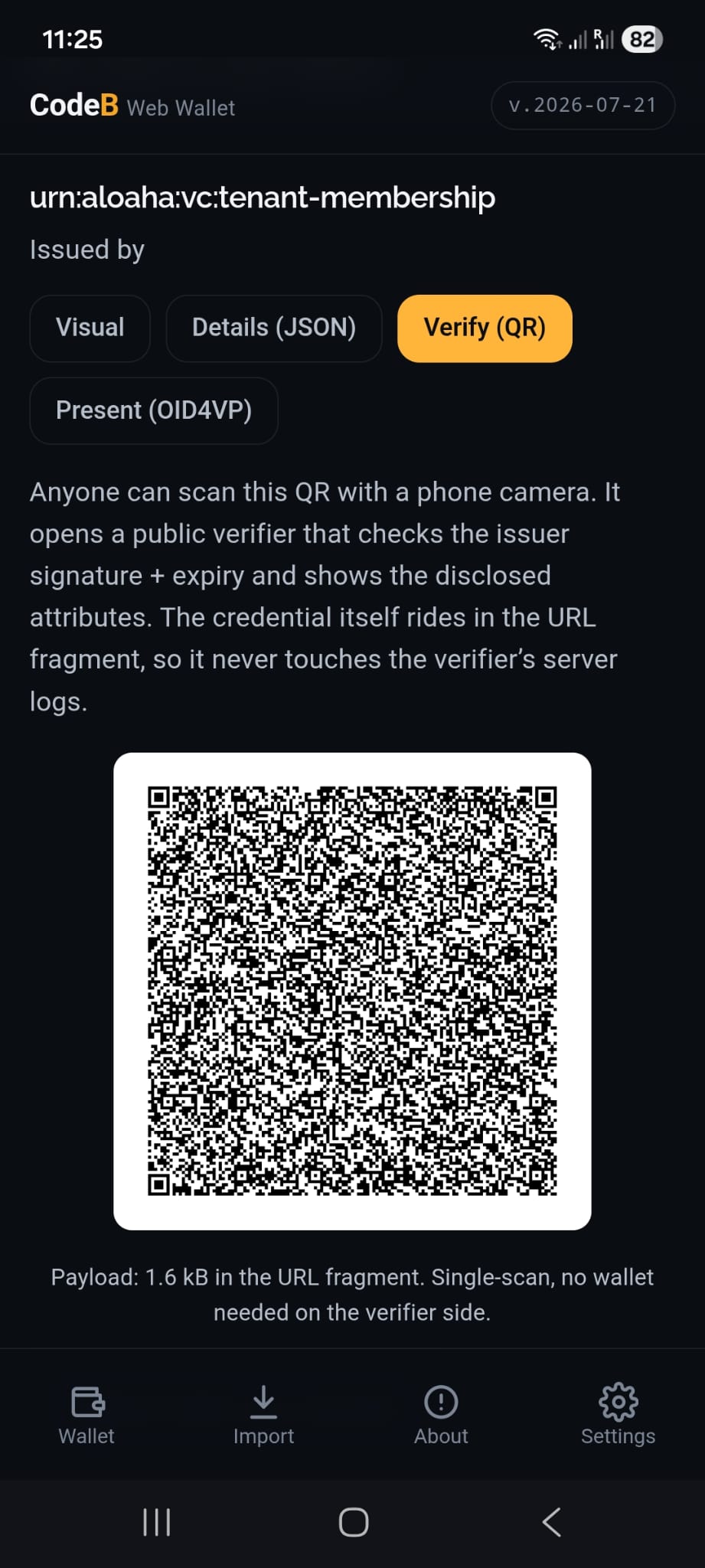
The wallet holder taps Verify (QR) on any credential. The full SD-JWT VC is POSTed to a per-tenant relay /vshare.ashx, which stores it under a 128-bit random opaque id and returns a short link. The QR encodes only that short link (~120 bytes), so it scans reliably from a phone screen across the room. The verifier fetches the credential by id, parses it in the browser, and shows a physical-mimic ID card with the disclosed attributes and a green VALID / red INVALID cryptographic status. Anyone with a phone camera can verify; no wallet app required.
Configurable TTL
1 minute (shop counter, single scan) through 15 minutes (default), 1 hour, 1 day, 7 days, 30 days, 1 year, up to 2 years (public demo QR on LinkedIn / blog / conference badge). Filename-encoded expiry, sweep-on-write, hard clamp at the handler.
Portrait via URL
PID + mDL credentials carry a portrait_url claim covered by the issuer signature. The verifier renders the portrait via <image> pulling directly from the tenant's /portrait.ashx?id=…. Signature covers the URL string, so swapping the URL breaks the credential.
No installed wallet needed
Verifier is a static page with WebCrypto. Fetches issuer JWKS via /.well-known/jwt-vc-issuer. Same page verifies PID, mDL, EHIC, mVRC, and any tenant-defined VCT.
Try it now — scan or click
Two live demo credentials. Scan a QR with your phone camera, or click it if you’re on a laptop. No wallet app required — the verifier opens in your browser and cryptographically checks the SD-JWT VC.
John CITIZEN
EU Digital Identity Wallet — Identity Card (PID)
Instead of scanning you can also click the QR to open the verifier directly.
Erika Mustermann
EU Digital Identity Wallet — Identity Card (PID)
Instead of scanning you can also click the QR to open the verifier directly.
Standards + interoperability
OID4VP 1.0 FINAL
HAIP 1.0 Final mandates x509_hash. x509_san_dns is supported as an additional OpenID4VP compatibility mode for legacy wallets and is not part of HAIP Final. Presentations use JWE ECDH-ES A128GCM/A256GCM envelopes.
OID4VCI
Pre-authorized_code flow with dynamic vct resolution and holder-binding via cnf.jwk.
SD-JWT VC
Draft 07-compliant parsing + selective disclosure + KB-JWT with sd_hash.
W3C VCDM 2.0
JSON credential + @context, JOSE envelope typ=vc+jwt, ES256 signed. Issuer at /vcdm.ashx?action=issue, verifier at ?action=verify. Ships alongside SD-JWT VC.
W3C DID Core 1.0
Tenant publishes did:web:<host> at /.well-known/did.json. Resolver at /did.ashx?did=… handles did:key, did:jwk, did:web, did:webvh with SSRF-guard.
W3C Bitstring Status List v1.0
Compressed gzipped bitstring with multibase-u encoding, published as a signed VC-JWT with 7-day freshness. Bit-flip requires admin bearer.
ETSI TS 119 602/612 Trusted List
Tenant publishes its own LoTE at /.well-known/trust-list.xml, XMLDSig enveloped ECDSA-SHA256, exclusive C14N. Plus a JSON mirror.
HAIP §5.11 Wallet Provider
Metadata JWT at /.well-known/wallet-provider.jwt. Mints WUA (12-month Unit Attestation) + WIA (24-hour Instance Attestation) for attest_jwt_client_auth.
ISO/IEC 18013-7
mDoc online-presentation profile advertised in vp_formats_supported.mso_mdoc.iso18013-7_profile_supported.
WebAuthn Level 3 PRF
Passkey-based key derivation per draft-ietf-webauthn-prf.
WebCrypto only
All crypto via window.crypto.subtle. Non-extractable keys where possible. No JavaScript polyfills.
Same-origin CSP
Wallet page enforces strict CSP so no third-party script can exfiltrate the vault DEK during its brief in-memory window.
How it fits alongside the native EUDI Wallet
When the government-notified EUDI Wallet Instance for a Member State ships, users who want LoA-High and hardware-anchored PID belong there. This browser holder complements it, not competes with it. Use it for the audience the native app doesn't reach: older users, corporate desktops, first-touch onboarding, sector-specific credentials where LoA-Substantial is fit-for-purpose, or as a fallback when the native app isn't installed yet.
Read next
- Verifier live demo (OID4VP 1.0 FINAL)
- HAIP conformance evidence
- Age verification demo
- Verify a wallet credential (Share-QR public verifier) — scan a wallet-holder's Verify-QR from any phone camera; checks signature + expiry + disclosures + status-list bit entirely in the verifier's browser.
- Membership cards cookbook — tenant playbook for issuing member VCs into wallets and verifying them at the door.
- Machine-readable /openapi.json